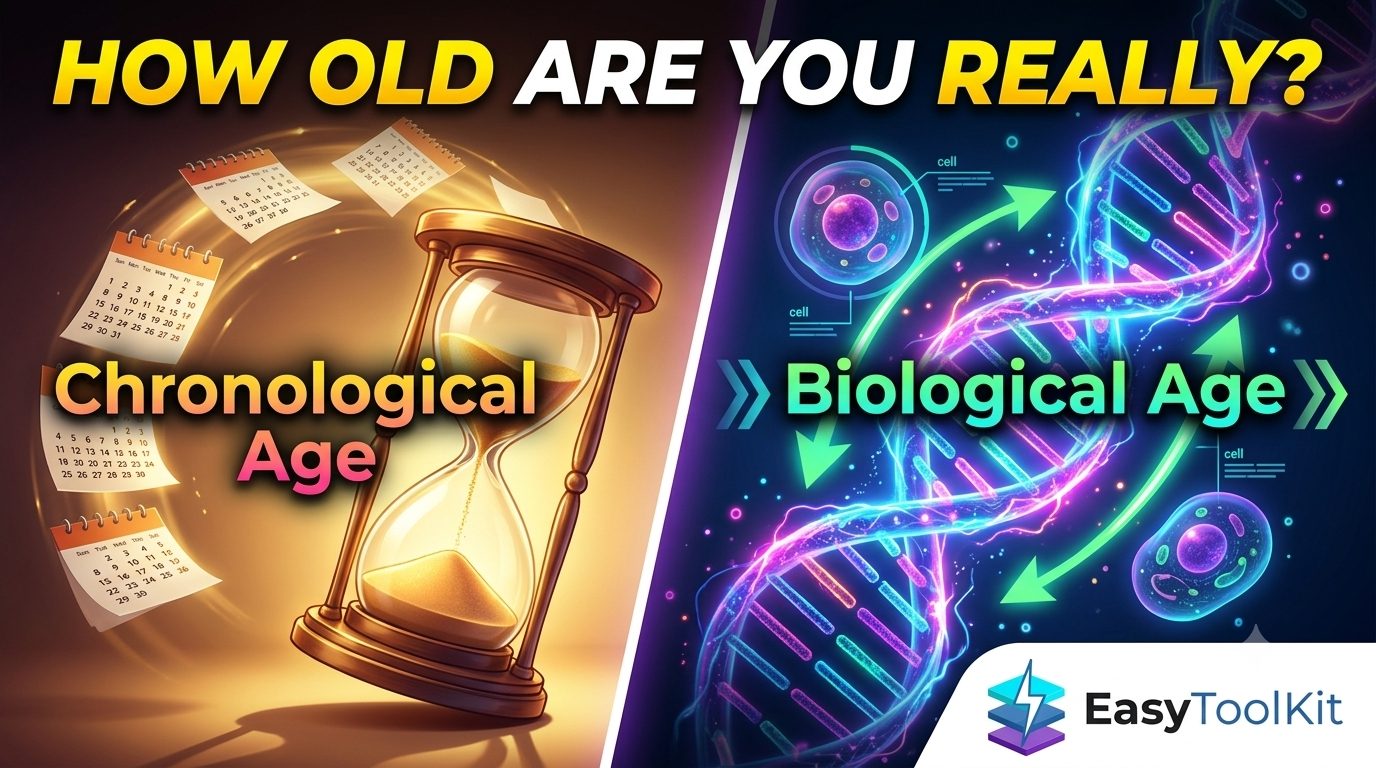
Have you ever met two people who are both exactly 50 years old, yet one looks and moves like a vibrant 35-year-old while the other struggles with the joint pain and low energy typically associated with a 70-year-old?
This stark contrast highlights the fascinating difference between chronological age vs biological age. While time moves at the exact same pace for everyone, your body does not.
Understanding how these two numbers diverge is the ultimate key to unlocking longevity, optimizing your healthspan, and taking control of your cellular destiny. If you want to know how old you truly are inside, you must look past the calendar—but you still need to know exactly where your calendar baseline stands.
Before diving into the complex science of cellular health, it is vital to know your precise chronological baseline down to the exact day. You can instantly find this using our free, high-precision Age Calculator. Knowing this exact number provides the essential foundation needed to measure your true rate of aging.
What is Chronological Age?
Chronological age is the most straightforward measurement of time in your life. It is the total number of years, months, and days that have passed since the moment you were born.
Every time you celebrate a birthday, your chronological age increases by one. It is a fixed, immutable metric. You cannot slow it down, speed it up, or alter it in any way.
In society, chronological age serves as a universal baseline. It determines when you are legally allowed to drive, vote, purchase alcohol, and collect retirement benefits.
However, calculating it manually down to the exact day, week, or hour can be surprisingly tricky due to leap years and varying month lengths. To eliminate the guesswork, you can use a digital tool like the EasyToolkit Age Calculator to get an instantaneous, error-free breakdown of your exact time on Earth.
Yet, as a metric for personal health, chronological age is deeply flawed. It tells us absolutely nothing about the internal state of your organs, the efficiency of your immune system, or your risk of developing age-related chronic illnesses.
What is Biological Age?
Biological age, often referred to as physiological age or phenotypic age, measures how old your cells and tissues actually are based on their physiological health and functional capacity.
Unlike the calendar, your biological age is highly dynamic. It reflects the true accumulation of cellular damage, metabolic efficiency, and systemic inflammation inside your body.
If your biological age is lower than your chronological age, your body is aging slower than average, which correlates with a lower risk of age-related disease. If your biological age is higher, it means your cells are experiencing accelerated aging, leaving you more vulnerable to premature decline.
The most exciting aspect of biological age is that it is not set in stone. Because it is heavily influenced by your environment, diet, and lifestyle, you have the power to influence, stabilize, and even reverse it.
The Core Science: Why Do the Two Ages Diverge?
To truly comprehend the debate of chronological age vs biological age, we must look deep inside the microscopic world of human biology. Your cells are constantly replicating, repairing, and responding to external stressors. The speed at which these processes degrade dictates your biological rate of aging.
Cellular Senescence and the Zombie Cells
As cells divide throughout your life, they eventually reach a limit known as the Hayflick limit. At this point, they are supposed to undergo a natural process called apoptosis, or programmed cell death.
However, some damaged cells refuse to die. Instead, they turn into senescent cells, frequently called zombie cells. These cells linger in your tissues, secreting highly toxic, inflammatory molecules that damage surrounding healthy cells and accelerate biological aging.
Telomere Attrition and the Caps of Life
Inside the nucleus of every cell, your DNA is tightly packed into chromosomes. At the very tips of these chromosomes sit protective caps called telomeres. Think of telomeres like the plastic tips at the end of shoelaces that prevent them from fraying.
Every time a cell divides, its telomeres become slightly shorter. When telomeres become critically short, the cell can no longer divide and either dies or becomes senescent. Shorter telomeres are a primary hallmark of an advanced biological age.
Epigenetic Changes and the Molecular Clock
Your DNA sequence is like a permanent instruction manual. However, your epigenome acts as a set of tags or switches that decide which instructions are read and which are ignored. This process is called gene expression.
As time goes on, factors like poor diet, chronic stress, and environmental toxins cause negative changes to these epigenetic tags, particularly through a process called DNA methylation. These alterations cause your cells to forget their original functions, leading to systemic tissue decline.
Key Differences Between Chronological and Biological Age
To clearly map out how these two concepts operate, we must break down their characteristics across several distinct categories.
How it is measured:
- Chronological age is measured solely by time, using calendars, birth certificates, and public records. You can instantly map out your exact timeline using an automated tool like our online age calculator.
- Biological age is measured through advanced molecular biomarkers, including DNA methylation patterns, telomere length, blood inflammatory markers, and metabolic profiles.
Flexibility and control:
- Chronological age is completely fixed. It moves in only one direction at a constant speed of one year per year.
- Biological age is fluid and malleable. It can accelerate during periods of high stress or illness, and it can decelerate or reverse through targeted lifestyle interventions.
Relevance to health and vitality:
- Chronological age offers a general demographic baseline but fails to predict individual health outcomes accurately.
- Biological age is a highly precise predictor of healthspan, physical capability, cognitive function, and overall mortality risk.
Social and legal impact:
- Chronological age governs legal rights, retirement age, insurance brackets, and age-restricted milestones.
- Biological age has no current legal standing but heavily influences personalized medical care, functional fitness, and biological longevity.
How to Measure Your Biological Age
Thanks to recent breakthroughs in biotechnology and longevity science, measuring your biological age is no longer science fiction. You can access highly precise testing methods to discover your true internal age.
Step 1: Establish Your Chronological Baseline
Before ordering advanced medical diagnostics, you must establish an accurate baseline. Use the EasyToolkit Age Calculator to determine your exact age in years, months, days, and hours. Longevity algorithms require this hyper-precise input to accurately measure your variance rate.
Step 2: Epigenetic Clocks and DNA Methylation Testing
Epigenetic clocks are widely considered the gold standard for measuring biological age. These tests analyze specific patterns of DNA methylation across your genome. By looking at where methyl groups have attached to your DNA, advanced algorithms compare your cellular state against your chronological baseline to determine if you are aging faster or slower than average.
Step 3: Telomere Length Testing
This method measures the average length of the telomeres in your white blood cells. By comparing your telomere length to a vast database of individuals across various chronological age groups, the laboratory determines whether your cellular caps are longer or shorter than average for your peer group.
Step 4: Blood Biomarker Panels
Comprehensive blood panels that track standard biomarkers can provide excellent insights into your physiological rate of aging. Key markers to watch include:
- High-Sensitivity C-Reactive Protein (hs-CRP): A critical indicator of systemic inflammation.
- Fasting Insulin and HbA1c: Metrics that track your metabolic health and insulin sensitivity.
- Liver and Kidney Function Markers: Indicators like ALT, AST, and eGFR that reveal organ efficiency.
Top 5 Factors That Accelerate Biological Aging
If you want to keep your biological age lower than the calendar, you must identify and eliminate the hidden catalysts that force your cells to age prematurely.
Chronic, Unmanaged Stress
When you experience ongoing emotional or physical stress, your adrenal glands flood your body with cortisol and adrenaline. While these hormones are vital for short-term survival, chronic exposure degrades your brain structure, disrupts sleep, shortens telomeres, and triggers persistent systemic inflammation.
A Diet High in Ultra-Processed Foods
Consuming a diet loaded with refined sugars, industrial seed oils, and artificial additives acts as rocket fuel for biological aging. These foods lead to advanced glycation end-products (AGEs), which literally stiffen your proteins, damage your arteries, and cause widespread metabolic dysfunction.
Sedentary Lifestyle and Lack of Movement
Your body is fundamentally designed to move. A prolonged lack of physical activity causes your muscle mass to waste away (sarcopenia), decreases your mitochondrial density, and slows down your metabolic rate. Sitting for hours on end tells your cellular machinery that it no longer needs to maintain peak efficiency.
Chronic Sleep Deprivation
Sleep is the ultimate biological reset mechanism. While you sleep, your brain clears out metabolic waste via the glymphatic system, and your cells undergo vital DNA repair. Consistently sleeping less than seven hours per night cuts these repair windows short, causing rapid cellular damage accumulation.
Environmental Toxins and Pollutants
Every single day, your body is exposed to an array of synthetic chemicals, microplastics, heavy metals, and air pollution. If your liver and kidneys are overwhelmed by these environmental burdens, toxins build up in your tissues, leading to high levels of oxidative stress and accelerated mitochondrial decay.
Actionable Strategies to Reverse Your Biological Age
The beauty of longevity science is the realization that you possess immense control over your biological clock. By introducing targeted, evidence-based habits, you can optimize your cellular health and actively lower your biological age.
Optimize Your Nutrition Architecture
Shift your eating habits toward a whole-food, nutrient-dense framework that starves inflammation and feeds cellular repair. Focus heavily on:
- Incorporating a wide variety of colorful vegetables rich in polyphenols and antioxidants.
- Consuming clean, high-quality proteins to preserve vital muscle mass.
- Including healthy fats, such as extra virgin olive oil, avocados, and wild-caught fatty fish, to support cellular membrane integrity.
- Implementing periodic fasting or time-restricted eating windows to trigger autophagy, the process where your body cleans out broken cellular parts.
Implement a Strategic Exercise Matrix
To maximize cellular longevity, your fitness routine must combine two distinct types of physical exertion:
- Resistance Training: Lift weights, use resistance bands, or perform bodyweight exercises at least three times per week. Building and maintaining muscle is one of the strongest defenses against metabolic decline and physical frailty.
- Cardiovascular Conditioning: Mix steady-state zone 2 cardio (like brisk walking, cycling, or swimming) with occasional high-intensity interval training (HIIT). This dual approach boosts your mitochondrial capacity and optimizes your cardiovascular endurance.
Prioritize Radical Sleep Hygiene
Transform your sleep into a non-negotiable longevity therapy. Ensure you get seven to nine hours of high-quality sleep every single night by doing the following:
- Keeping your bedroom completely dark, quiet, and cooled down to roughly 65 degrees Fahrenheit.
- Eliminating all blue-light-emitting screens, including smartphones and televisions, at least one hour before heading to bed.
- Maintaining a strict, identical wake-up time every day of the week to align your natural circadian rhythms.
Master the Art of Stress Resilience
You cannot completely eliminate stress from modern life, but you can fundamentally change how your nervous system responds to it. Protect your cells by practicing:
- Daily mindfulness meditation or focused breathwork to stimulate your vagus nerve and activate your parasympathetic nervous system.
- Regular spending of time out in natural, green spaces, which has been shown to rapidly lower circulating cortisol levels.
- Cultivating deep, meaningful social connections with friends, family, and community members to combat loneliness.
Pro Tips for Longevity and Healthy Aging
- Track your data: Do not guess when you can measure. Utilize wearables to monitor your resting heart rate, heart rate variability (HRV), and sleep stages. Pair this data with regular tracking of your exact age milestones using an online calculator to celebrate your health wins precisely.
- Focus on micro-habits: Do not try to overhaul your entire life overnight. Pick one small, sustainable habit this week, such as drinking more water or walking for ten minutes after dinner, and anchor it firmly into your routine before adding another.
- Embrace positive stressors: Expose your body to controlled, brief bouts of stress, a concept known as hormesis. Activities like cold plunges, saunas, and intense exercise trigger protective cellular repair mechanisms that ultimately make you stronger and biologically younger.
Common Mistakes to Avoid
- Relying solely on expensive supplements: Many people spend thousands of dollars on unverified anti-aging pills while completely ignoring their terrible sleep schedules and highly processed diets. Supplements are meant to enhance a solid foundation, not replace it.
- Overtraining without adequate recovery: More exercise is not always better. Working out intensely every single day without providing your body time to rebuild leads to chronic overtraining, elevated cortisol, and accelerated biological degradation.
- Ignoring your birth timeline: Some health enthusiasts get so caught up in advanced biohacking metrics that they lose track of standard medical health screening windows based on chronological milestones. Keep an eye on your actual time-based age to ensure you never miss critical checkups.
Real-World Use Cases: Biological Age in Action
Personalized Insurance and Healthcare Optimization
Forward-thinking medical practitioners are moving away from treating patients based purely on their birth year. Instead, doctors utilize biological age assessments alongside precise chronological tracking to customize cancer screening schedules, tailor cardiovascular preventative therapies, and optimize hormone replacement strategies for the specific needs of the patient's actual tissues.
Executive and Athletic Performance Tracking
High-performing executives and elite athletes utilize biological age testing as the ultimate performance dashboard. By tracking changes in their biological clock quarter after quarter against their exact calendar time, they can immediately see if a high-stress corporate project or a grueling training cycle is causing excessive cellular damage, allowing them to adjust their recovery strategies before burnout occurs.
Conclusion: Take Control of Your Biological Clock
When comparing chronological age vs biological age, the most vital takeaway is clear: your calendar age is completely out of your hands, but your biological age is a direct reflection of the choices you make every single day.
You do not have to accept physical decline as an inevitable consequence of accumulating birthdays. By prioritizing deep sleep, clean nutrition, intelligent physical training, and true stress resilience, you can slow down your internal clock, extend your healthspan, and ensure that your years are filled with vibrant, youth-like energy.
Take your first step today. Figure out your precise time baseline, choose one small longevity habit, stick to it consistently, and start reclaiming control over your cellular destiny.
Ready to Calculate Your Exact Chronological Age?
Managing your longevity journey begins with a flawless understanding of your exact timeline. Don't waste time trying to calculate tricky calendar days and leap years manually. Use our quick, 100% free online Age Calculator to discover your exact chronological age in years, months, weeks, and days instantly.
While you are there, explore the rest of the clean digital toolsets available at EasyToolkit to help simplify, streamline, and optimize your daily health and productivity schedules!